
AeroGenie — Uw intelligente copiloot.

Trending
Categories
Common Misconceptions About the Boeing 787 Dreamliner
Common Misconceptions About the Boeing 787 Dreamliner
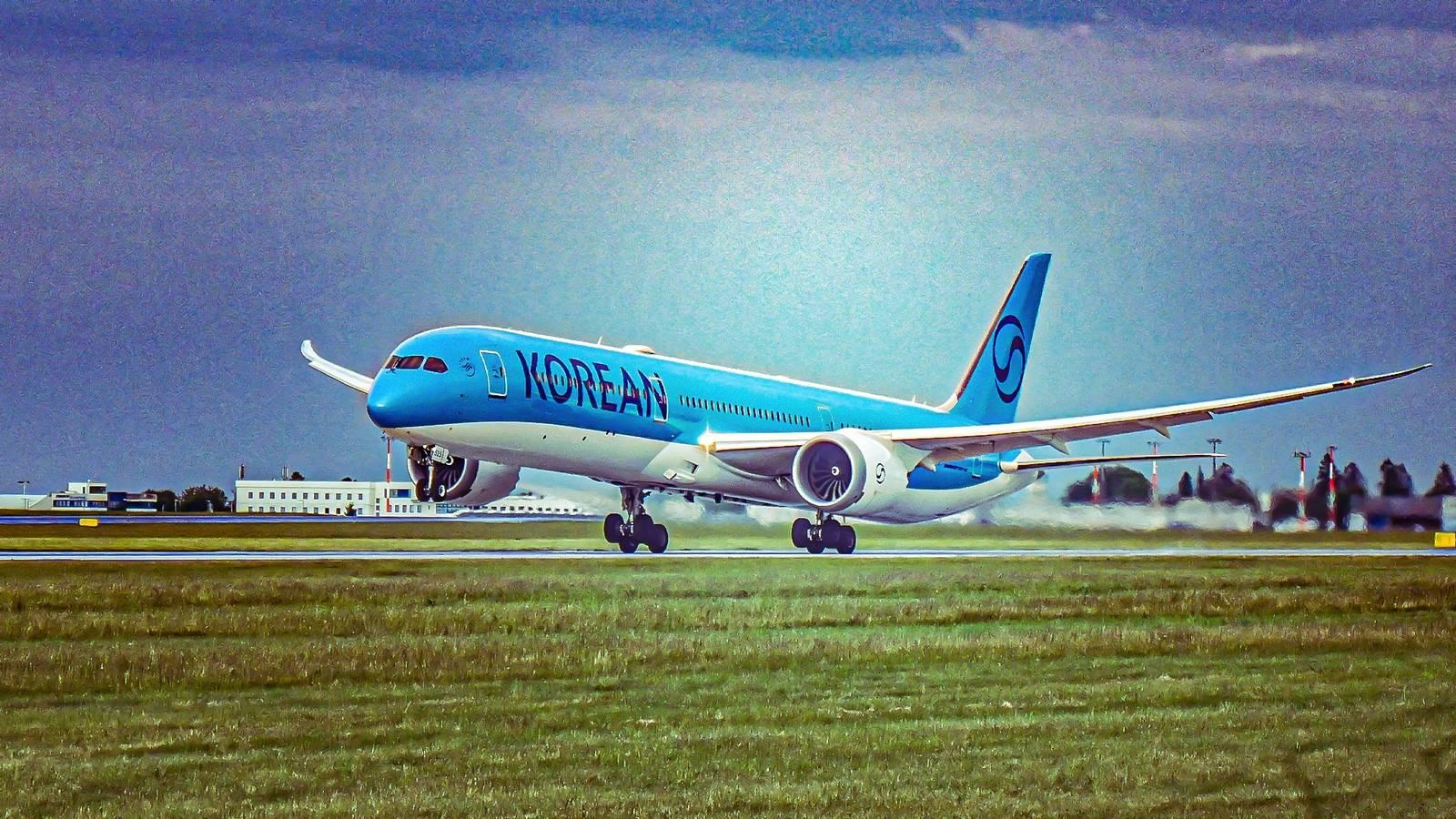
The Boeing 787 Dreamliner is widely regarded as one of the most innovative and versatile aircraft in contemporary aviation. Engineered as a widebody jet with ultra-long-haul capabilities, the 787 is smaller and more fuel-efficient than earlier long-range models such as the Boeing 747 and 777. This design enables airlines to operate demanding routes with reduced financial risk and improved economics. Notably, the 787’s fuel efficiency extends beyond long-haul flights to shorter sectors as well, marking a significant advancement over predecessors like the Boeing 777-200LR, which tended to consume more fuel on shorter journeys.
Design and Efficiency
Central to the Dreamliner’s efficiency is its clean-sheet design, which incorporates a highly aerodynamic airframe and advanced wing structures that outperform older aircraft such as the Airbus A330. The 787 offers two engine options—the General Electric GEnx and the Rolls-Royce Trent 1000—both recognized among the most fuel-efficient engines currently available. Boeing has emphasized the extensive use of advanced materials in the 787’s construction, often highlighting that approximately 50% of the aircraft’s structure is composed of carbon-composite materials. This significantly reduces the aircraft’s weight and contributes to its performance. However, it is a common misconception that the entire airframe is made of composites; in reality, the remaining structure primarily consists of traditional aluminum alloys.
Variants and Operational Highlights
The Dreamliner family comprises three principal variants: the original 787-8, the larger and more popular 787-9, and the stretched 787-10. The 787-9, which entered service in 2014, offers the longest range of up to 7,565 nautical miles (14,010 kilometers) and has become the most widely ordered model, with over 1,400 orders—nearly rivaling the Airbus A350 family. This variant operates five of the world’s ten longest nonstop flights and set a record for the longest scheduled flight when Air Tahiti Nui flew from Papeete to Paris, covering 9,765 nautical miles (15,715 kilometers) in 2020. While the 787-8 was the program’s pioneering model, it has been largely eclipsed by the 787-9’s superior economics and extended range. The 787-10, introduced in 2018, is gaining market traction due to its low per-seat operating costs and its suitability as a replacement for the Boeing 777-200ER. Recent increases in the Maximum Takeoff Weight (MTOW) for the 787-9 and 787-10 variants are expected to enhance their appeal further, particularly benefiting the 787-10.
Challenges and Market Outlook
Despite its technological achievements, the Dreamliner program has encountered ongoing challenges. Production delays and quality control issues have resulted in shifting delivery schedules and heightened scrutiny from the Federal Aviation Administration (FAA), especially as Boeing advances certification efforts for new models such as the MAX 7. In an effort to bolster production quality and supply chain resilience, Boeing completed a $4.7 billion acquisition of Spirit AeroSystems. Market confidence remains robust, as evidenced by a 7% surge in Boeing’s shares following CFO Jay Malave’s projection of increased deliveries for both the 737 and 787 aircraft in the coming year. Meanwhile, competitors remain watchful, with airlines like China Southern Airlines continuing to deploy the 787 on key international routes, including Guangzhou to Sydney.
While the Boeing 787 Dreamliner is often subject to misconceptions—particularly regarding its composite construction—it continues to set a benchmark for efficiency and innovation in long-haul air travel. As Boeing addresses its production and certification challenges, the Dreamliner remains a pivotal aircraft shaping the future of global aviation.
Archer Aviation Confronts Setbacks Amid Declining Air Taxi Interest
Chinese Team Develops First Flight Control Software for Bamboo Drones
Government Moves Forward with Boeing Purchase, Considers Airbus Leasing
SkyHope Appoints Aviation Industry Leader to Board
The Challenges of Certifying Autonomous Aircraft
KLM to Receive First Airbus A350, Announces Initial Routes
Saxon Air Receives Clean and Green Energy Innovation Award
How BEB Tax Policies Impact Airlines’ International Leasing Contracts

Indonesia’s Danantara and Mandiri Partner with SMBC to Launch $800 Million Aviation Leasing Fund
South Korea’s SUM Air Places Order for New ATR Aircraft
