
AeroGenie — Uw intelligente copiloot.

Trending
Categories
BA Chief Warns AI Agents May Diminish Brand Visibility
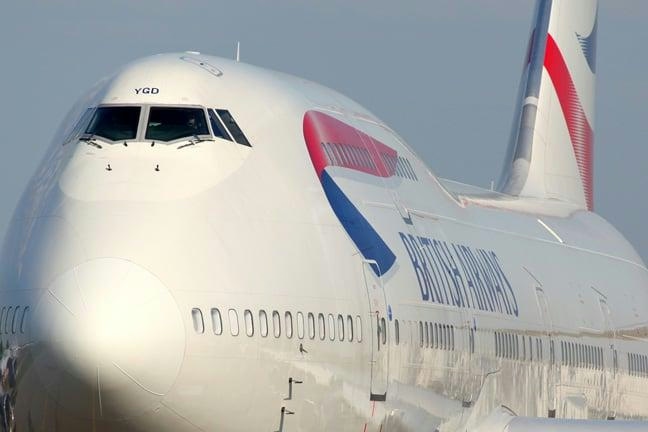
BA Chief Warns AI Agents May Diminish Brand Visibility
The Emerging Role of AI in Airline Competition
British Airways’ Chief Executive Sean Doyle has issued a stark warning about the transformative impact of artificial intelligence agents on the airline industry’s competitive landscape. Speaking at Globant’s Converge 2025 event in London, Doyle highlighted a future where automated AI systems, rather than human consumers, increasingly determine which airlines secure bookings. This shift threatens to marginalize traditional brand visibility if airlines fail to adapt to the new digital environment.
Doyle emphasized that the era when a strong website and high search engine rankings guaranteed customer attention is rapidly fading. Instead, AI agents and bots are poised to become intermediaries between consumers and travel brands, selecting options based on algorithms that prioritize price, convenience, and other quantifiable factors. This development presents an existential challenge for airlines, hotels, and travel companies, as their offerings may be chosen less by direct human engagement and more by machine-driven optimization.
Strategic Responses and Digital Transformation
Acknowledging that British Airways is “probably behind the curve” in digital transformation, Doyle described the airline’s ongoing efforts as a “leapfrog opportunity” to modernize its operations. Central to this strategy is the creation of a new digital foundation designed to accelerate product launches and enhance responsiveness to evolving customer expectations. A key element of this transformation is hyper-personalization, leveraging the extensive data generated by individual customers throughout their journey—from booking to boarding. Historically siloed, this data is now being integrated to improve service delivery, particularly during disruptions.
Doyle also framed AI-driven automation not as a threat to employment but as a means to redeploy staff toward more valuable, customer-facing roles. He envisions agentic AI revolutionizing labor-intensive legacy processes that have accumulated over decades, thereby enhancing operational efficiency without sacrificing human interaction.
Broader Industry Implications
Industry experts suggest that the rise of AI agents will fundamentally alter consumer purchasing behavior, with bots potentially negotiating purchases collectively and influencing retail pricing strategies. To remain competitive, companies may need to conduct regular AI visibility audits, optimize content for AI-driven searches, and ensure their products are discoverable by automated systems. Failure to integrate AI effectively could render brands increasingly invisible in a marketplace where human attention is no longer the primary currency.
Doyle’s message to the airline industry is unequivocal: rapid adaptation to the AI-driven landscape is essential to avoid fading from the digital marketplace altogether.
Chinese Team Develops First Flight Control Software for Bamboo Drones
SkyHope Appoints Aviation Industry Leader to Board
The Challenges of Certifying Autonomous Aircraft
KLM to Receive First Airbus A350, Announces Initial Routes
Saxon Air Receives Clean and Green Energy Innovation Award
How BEB Tax Policies Impact Airlines’ International Leasing Contracts
Indonesia’s Danantara and Mandiri Partner with SMBC to Launch $800 Million Aviation Leasing Fund
South Korea’s SUM Air Places Order for New ATR Aircraft
Benoît Rollier Named Vice President of KLM Engine Service
Azorra Expands Engine Portfolio Through Deal with DAE
