
AeroGenie — Votre copilote intelligent.

Tendances
Categories
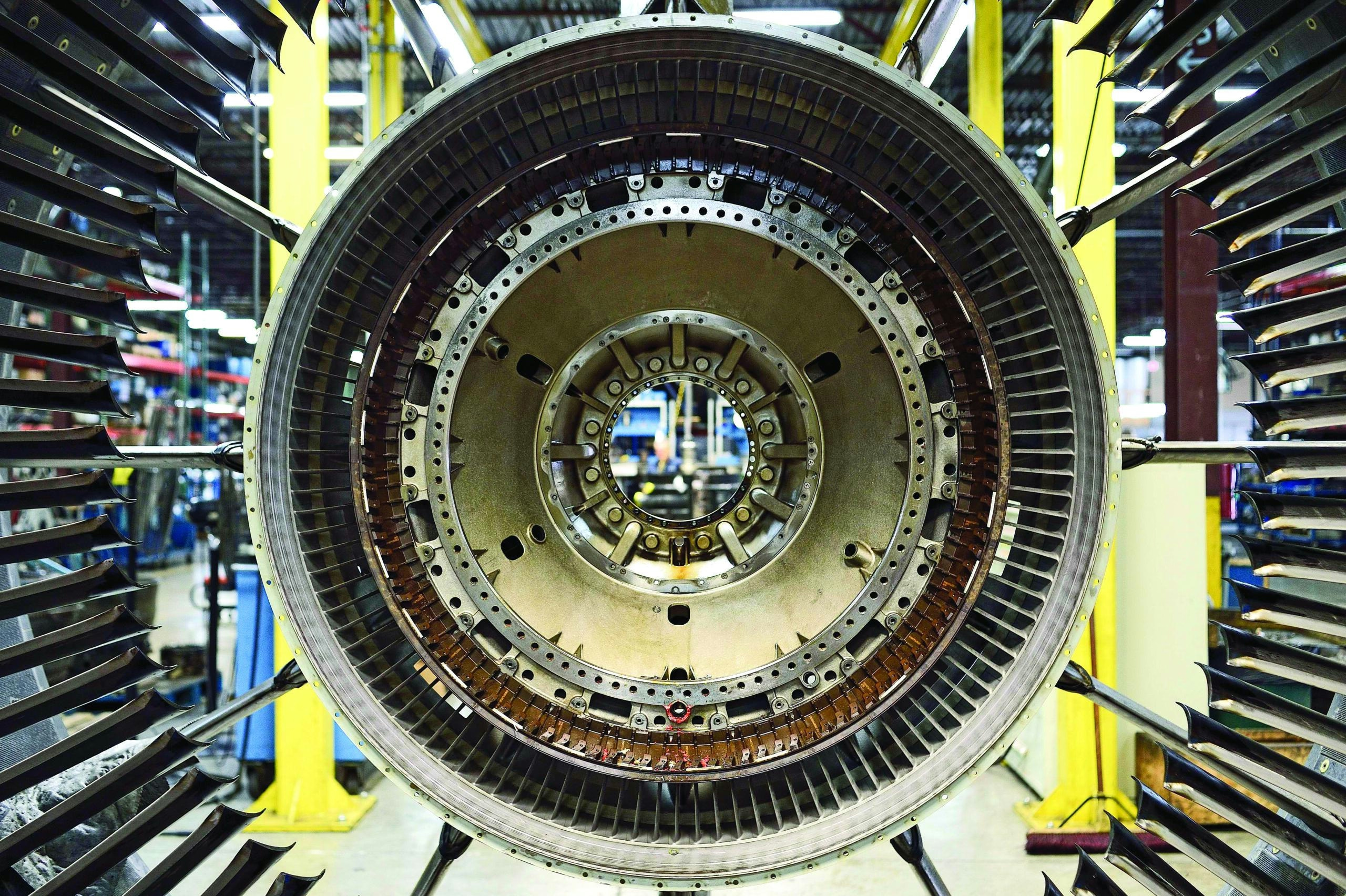
MRO Outlook: A Quick-Turn Perspective
MRO Outlook: A Quick-Turn Perspective
Rising Passenger Demand and Its Impact on Maintenance
Global passenger traffic continues to grow robustly, with the International Air Transport Association (IATA) reporting a 5.3% year-on-year increase and consistently high load factors. While this surge signals positive momentum for airlines, it simultaneously intensifies operational pressures across fleets, maintenance, repair, and overhaul (MRO) providers, and the broader aviation supply chain. Delays in the delivery of new-generation aircraft and engines have compelled airlines to extend the service life of older aircraft beyond initial plans. This divergence between fleet renewal schedules and actual deliveries has emerged as a defining challenge in the current market environment.
The extended reliance on aging aircraft carries significant financial and operational consequences. Maintenance activities escalate in frequency and complexity, parts consumption rises, and workscopes expand, resulting in longer turnaround times and increased maintenance expenditures. Engines such as the CFM56-7B exemplify this pressure point, with full shop visits costing between $5 million and $7 million, and limited performance restorations approaching $3.5 million. For airlines already heavily investing in new aircraft acquisitions or leases, justifying the expense of multiple shop visits on older engines becomes increasingly difficult.
Collaborative Ecosystem and Evolving Maintenance Strategies
The strain of these challenges extends beyond airline operators to encompass lessors, original equipment manufacturers (OEMs), MRO providers, and suppliers, all of whom are interconnected in the shared objective of ensuring safe, reliable, and cost-effective passenger transport. When any segment of this ecosystem experiences stress, the repercussions ripple throughout the entire system, necessitating close collaboration among all stakeholders.
In response, airlines and lessors are reevaluating their engine maintenance strategies, adopting more progressive and flexible approaches to navigate the current cycle. Rather than defaulting to comprehensive shop visits, many are embracing targeted solutions such as module swaps, particularly for modular engines like the CFM56. Given that different engine modules have varying life limits, selective replacement often proves more practical and cost-effective than full overhauls. Operators increasingly replace life-limited parts (LLP)-expired modules with green-time units to maintain engines on wing while awaiting new aircraft or engine deliveries. These “quick turn” or “hospital shop” visits concentrate on essential maintenance tasks, treating the engine as a continued-time asset to maximize remaining value with minimal cost and downtime.
Smaller, agile MRO providers are especially well-positioned to deliver these targeted workscopes efficiently, without the overhead associated with full overhaul programs. Consequently, quick-turn shop visits—referred to by AerFin as engine MRO Lite—and module swap strategies are gaining significant traction across the market.
Market Challenges and Future Outlook
This strategic shift toward quick-turn maintenance introduces new challenges. As more operators adopt these solutions, concerns arise regarding the availability of green-time modules necessary to meet growing demand. The engine aftermarket, particularly for CFM56 engines, is experiencing bottlenecks in both testing capacity and material supply. Lengthy on-wing testing or repairs conducted at third-party facilities can result in waiting periods of four to six months. Simultaneously, some MROs are reallocating resources toward newer engine models such as the CFM Leap, which itself faces limited availability of used serviceable material and extended turnaround times ranging from seven to ten months.
These evolving dynamics are driving increased demand for rapid hospital repairs and modular replacements, while compelling MRO shops to prioritize maintenance of newer engine types. As the market continues to adapt, the ability to balance immediate, cost-effective maintenance solutions with long-term fleet renewal strategies will be critical for all participants within the aviation maintenance ecosystem.
Archer Aviation Confronts Setbacks Amid Declining Air Taxi Interest

Chinese Team Develops First Flight Control Software for Bamboo Drones
Government Moves Forward with Boeing Purchase, Considers Airbus Leasing

SkyHope Appoints Aviation Industry Leader to Board
The Challenges of Certifying Autonomous Aircraft
KLM to Receive First Airbus A350, Announces Initial Routes
Saxon Air Receives Clean and Green Energy Innovation Award
How BEB Tax Policies Impact Airlines’ International Leasing Contracts

Indonesia’s Danantara and Mandiri Partner with SMBC to Launch $800 Million Aviation Leasing Fund
South Korea’s SUM Air Places Order for New ATR Aircraft
