
AeroGenie — Votre copilote intelligent.

Tendances
Categories
Lufthansa Technik Growth Fueled by Future Investments
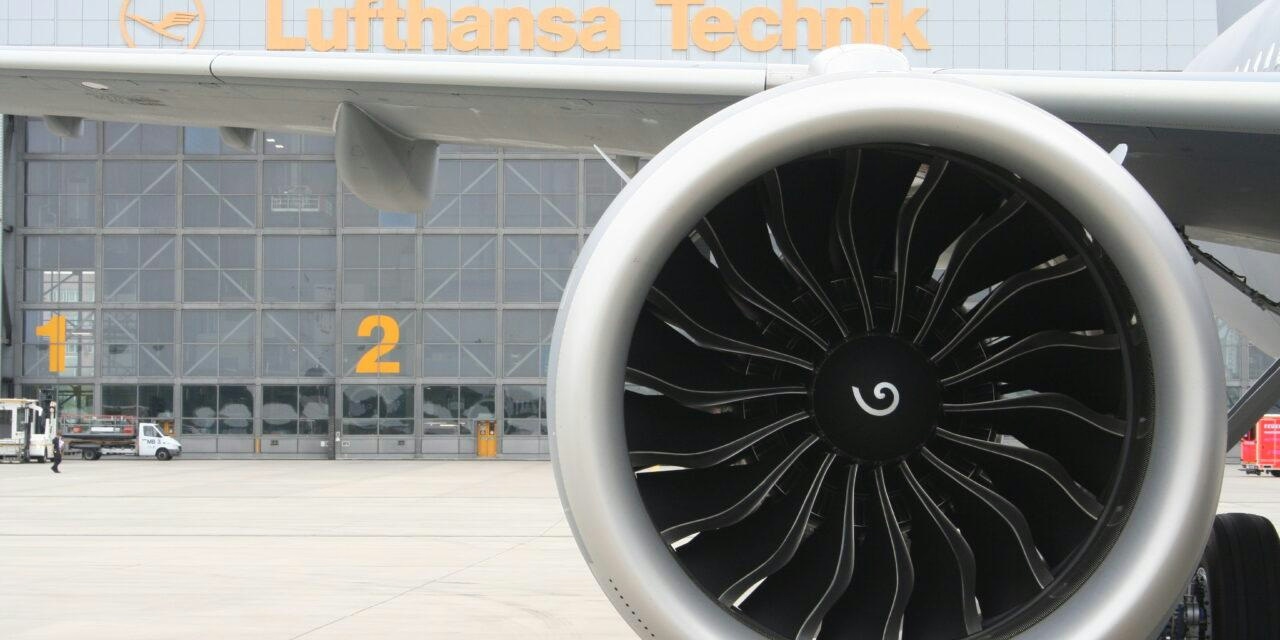
Lufthansa Technik Growth Fueled by Future Investments
Lufthansa Technik has reported strong financial results for 2025, driven by an ambitious investment strategy aimed at expanding its global maintenance, repair, and overhaul (MRO) network. The company’s revenue increased by 12% to €8.049 billion, surpassing the €8 billion threshold for the first time. Adjusted earnings before interest and taxes (EBIT) remained stable at €603 million, although profit margins declined to 7.5% due to rising material costs, US tariffs, and an unfavorable exchange rate against the dollar.
Strategic Expansion and Investment Plans
Central to Lufthansa Technik’s growth is a commitment to invest over €2 billion in the next five years to enhance its facilities and expand its component pool. This investment underpins the company’s confidence in its long-term trajectory despite ongoing geopolitical and economic uncertainties. Notably, approximately 75% of Lufthansa Technik’s revenue now originates from customers outside the Lufthansa Group, underscoring its expanding international presence.
Several major projects are currently underway to increase capacity and capabilities. In Hamburg, the company is constructing new workshop buildings, while a logistics center for engines and spare parts has recently opened in Alzey. In Portugal, a new repair facility near Porto is under construction, with completion expected in 2027; this site is projected to employ up to 700 people. On a global scale, Lufthansa Technik is exploring additional aircraft overhaul capacity in the Asia-Pacific region. In North America, a new engine repair facility featuring an integrated test stand is being developed in Calgary, alongside expanded component repair capacity at the Tulsa site.
Diversification and Competitive Challenges
Beyond its core MRO services, Lufthansa Technik is broadening its portfolio by supporting specialized military programs such as Germany’s PEGASUS signal intelligence aircraft and the German Navy’s P-8A Poseidon fleet. Its Digital Tech Ops Ecosystem, which includes platforms like AVIATAR, flydocs, and AMOS, now supports operators managing approximately 11,000 aircraft worldwide.
The competitive environment is intensifying as other industry players also enhance their service offerings and infrastructure. Embraer’s recent contract to support Hungarian Air Force C-390 aircraft and RTX’s MRO investments in Singapore exemplify the sector’s focus on global expansion. Meanwhile, Lufthansa Technik faces challenges such as labor shortages in the Middle East MRO market, where rapid regional growth combined with pandemic-related workforce gaps has created staffing pressures.
Despite these headwinds, Lufthansa Technik’s substantial investment program and global expansion initiatives position the company to meet rising demand for MRO services, reinforcing its status as a leading player in the evolving aviation maintenance industry.
Archer Aviation Confronts Setbacks Amid Declining Air Taxi Interest
Chinese Team Develops First Flight Control Software for Bamboo Drones
Government Moves Forward with Boeing Purchase, Considers Airbus Leasing
SkyHope Appoints Aviation Industry Leader to Board
The Challenges of Certifying Autonomous Aircraft
KLM to Receive First Airbus A350, Announces Initial Routes
Saxon Air Receives Clean and Green Energy Innovation Award
How BEB Tax Policies Impact Airlines’ International Leasing Contracts
Indonesia’s Danantara and Mandiri Partner with SMBC to Launch $800 Million Aviation Leasing Fund
South Korea’s SUM Air Places Order for New ATR Aircraft
