
AeroGenie — Ihr intelligenter Copilot.

Trends
Categories
Key Differences Noted by Cabin Crew Between Boeing 787 and Airbus A350
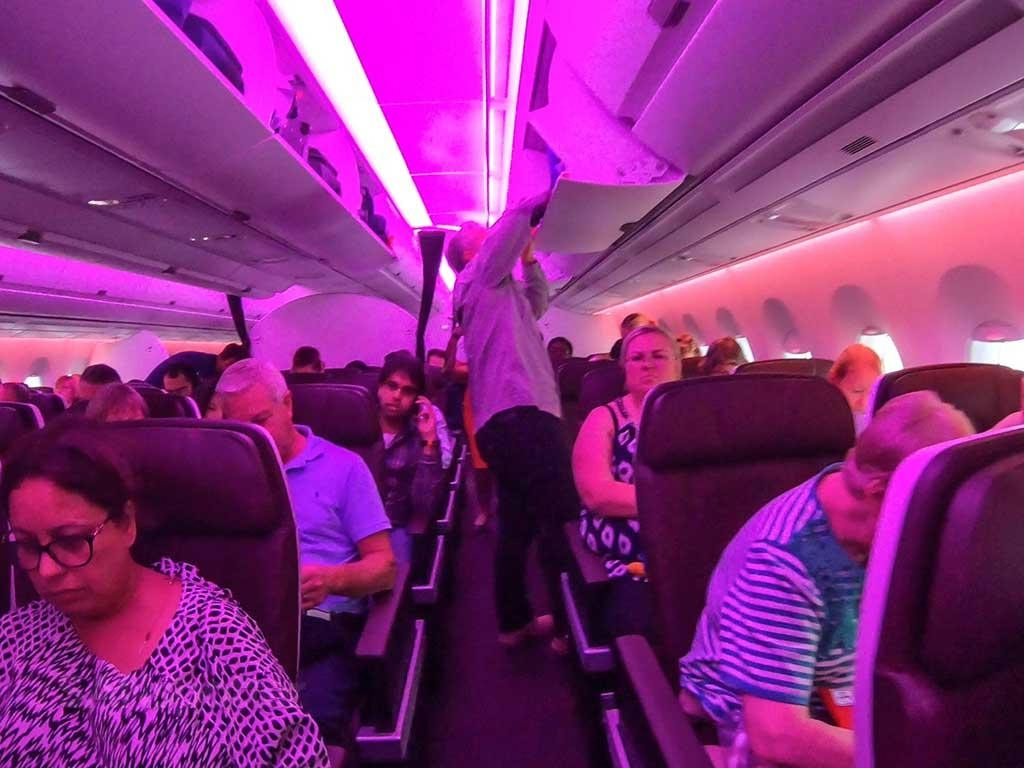
Key Differences Noted by Cabin Crew Between Boeing 787 and Airbus A350
The Airbus A350 and Boeing 787 Dreamliner represent two of the most advanced widebody aircraft currently in service, frequently compared for their technological innovation, fuel efficiency, and passenger comfort. Both models incorporate extensive use of lightweight carbon fiber composites and are engineered for long-haul operations with twin-engine configurations. While the Boeing 787 is widely recognized for its operational versatility, the newer Airbus A350 is distinguished by its unique "raccoon mask" cockpit window design.
Design and Operational Characteristics
Despite their many similarities, cabin crew members often identify notable differences between the two aircraft. The A350 boasts a longer range and greater passenger capacity, measuring 243 feet (74 meters) in length, compared to the 787’s 207 feet (63 meters). The 787 is lighter and slightly smaller, featuring highly flexible wings that visibly flex during flight, enhancing aerodynamic efficiency. Its fuselage is constructed from barrel sections, whereas the A350 employs a four-panel fuselage design. These structural distinctions contribute to differing flight characteristics and maintenance considerations.
From the perspective of cabin crew, adapting to the distinct cabin layouts and onboard systems of each aircraft can present operational challenges. Variations in galley arrangements, safety systems, and overall cabin configuration often necessitate additional training for crew members transitioning between the two types. Such differences influence crew preferences and can impact airline decisions when selecting new aircraft for their fleets.
Economic and Market Considerations
Economically, the A350 and 787 are closely matched but exhibit subtle distinctions. According to Air Insight, the A350’s extended range and higher seating capacity translate into a lower seat-to-mile cost of $0.1210 per seat mile. Conversely, the 787’s lighter weight results in a lower cost per aircraft mile and a reduced cost per block hour—$16,899 compared to the A350’s $18,370. While the A350’s cost per seat mile is approximately three percent lower, the 787 offers an eight percent advantage in block hour costs. Purchase prices for both aircraft overlap, with the A350 ranging from $300 million to $366 million and the 787 from $248 million to $338 million.
Both aircraft target similar market segments but differ in variant offerings. Boeing provides three 787 variants—the 787-8, 787-9, and 787-10—serving as replacements for older models such as the Airbus A330 and Boeing 767. Airbus offers two primary A350 versions—the A350-900 and A350-1000—aimed at supplanting larger aircraft like the Boeing 777-300ER. The 787-9 and A350-900 are particularly popular among airlines and are frequently compared directly.
Impact on Airline Decisions and Manufacturer Strategies
Market responses to these differences can be significant. Airlines often weigh crew feedback regarding onboard systems and operational ease when choosing between the two aircraft, influencing future fleet compositions. In turn, both Boeing and Airbus continue to refine their designs, emphasizing enhancements that improve crew experience and operational efficiency to maintain competitiveness in the widebody market.
While the Airbus A350 and Boeing 787 remain closely matched in terms of performance and economics, nuanced differences in design, crew experience, and operational flexibility continue to shape strategic decisions by airlines and manufacturers alike.
Archer Aviation Confronts Setbacks Amid Declining Air Taxi Interest

Chinese Team Develops First Flight Control Software for Bamboo Drones
Government Moves Forward with Boeing Purchase, Considers Airbus Leasing
SkyHope Appoints Aviation Industry Leader to Board
The Challenges of Certifying Autonomous Aircraft
KLM to Receive First Airbus A350, Announces Initial Routes
Saxon Air Receives Clean and Green Energy Innovation Award
How BEB Tax Policies Impact Airlines’ International Leasing Contracts

Indonesia’s Danantara and Mandiri Partner with SMBC to Launch $800 Million Aviation Leasing Fund
South Korea’s SUM Air Places Order for New ATR Aircraft
